
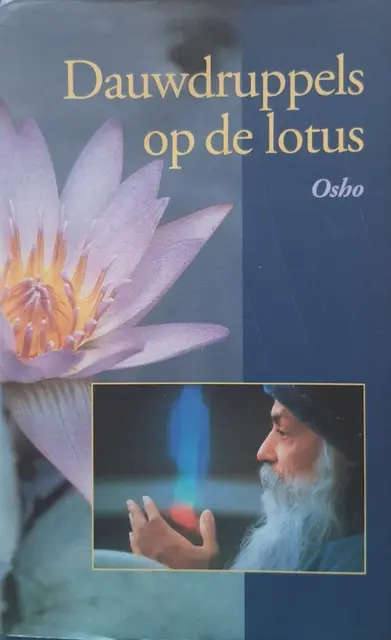

Dauwdruppels op de lotus
Osho
€ 6.95
In stock (only 1 copy left). Shipping € 4.55 (in the Netherlands; for other rates see Terms and shipping).
Sadly, this book has been sold.
- Author
- Osho
- Publisher
- Osho Publikaties
- ISBN
- 9789071985447
- Language
- Dutch
- Condition notes
- 1997, 184 pp, hardback, dust jacket, used
- Category
- Spirituality and esotericism › Spirituality
About this book
THE WORDS IN this book need no introduction. They speak to us all: gems of wisdom about love, about life, about the world in which we live — about you and about me. A glance at any random page draws us into a new world, the world of Osho, the most brilliant mystic of our time.
What does require some introduction, however, are the extraordinary circumstances under which this book came into being.
In October 1985, Osho was arrested by fifteen heavily armed men. They had no arrest warrant, yet he was detained for twelve days, without the possibility of bail.
Charles Turner, the public prosecutor appointed by the United States government to handle the case – himself a devout Christian – described Osho as follows. Turner said that he ‘did not like looking at the man. He was small and unremarkable, but possessed a certain magnetism. His eyes gleamed; they radiated an almost devilish fire. There was something malevolent about him. ‘A number of detectives,’ he continued, ‘told me they had the same impression.’ He concluded: ‘I have never been able to find a single point in his favour. Even in a robber or a drug dealer, I always managed to find something positive.’ A man like Pontius Pilate was more cautious in his remarks.
After dragging Osho, chained and handcuffed, right across America, the US Department of Justice handed down its verdict. It accused Osho of violating US immigration laws, deported him and fined him nearly half a million dollars.
Thus began one of the strangest legends of our time. The long arm of American power reached across the globe. No sooner had Osho’s aeroplane landed in a country than the local authorities received a call from an American voice. Twenty-one ‘democratic’ countries succumbed to the pressure and refused to grant Osho a place to stay.
At one point, it seemed that Greece, the birthplace of Socrates, might have learnt from that mistake of the past and would be prepared to allow Osho to stay.
After all, Plato had already described how, at the time of Socrates’ poisoning by the Athenian Department of Justice, twenty-five hundred years ago, the terrible truth of what they were doing to this man began to dawn on them. Plato writes: “When the jailer entered and walked towards him, he said: “Socrates, at any rate, I shall not have to hold it against you, as I do with others, if you become angry with me and curse me when, on the government’s orders, I give you the poison to drink.
Lately, I have come to know you as the noblest, gentlest and bravest of all who have ever stayed here, and especially now I am certain that you are not angry with me but with them. After all, you know who is responsible for this. So now — you know what I mean — farewell. Try to endure the inevitable as best you can.’ As he spoke, he burst into tears. He turned round and walked away.’
It was not to be. The authorities of modern-day Greece, who, like their American counterparts, ‘acted on the government’s orders’, had learnt nothing. Just as with Socrates, the priests and politicians conspired to accuse Osho of having a bad influence on young people and of posing a threat to the morals of society. Surrounded by a horde of armed police officers escorting him to his aeroplane, Osho asked the jostling journalists: “What sort of civilisation is this, in which, after two thousand years, your morals can be threatened by a single man on a two-week tourist visa?”