
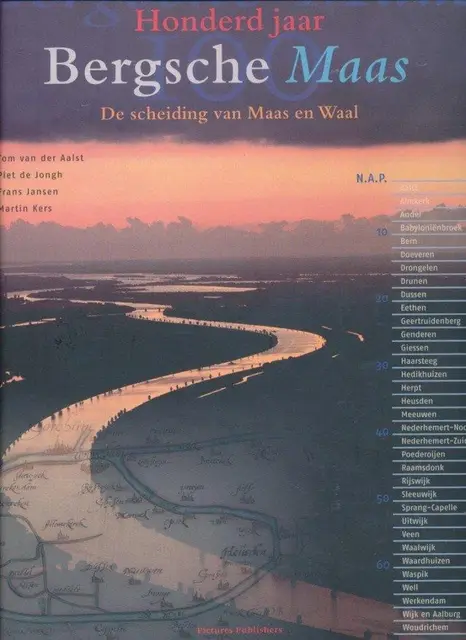
Honderd jaar Bergsche Maas. De scheiding van Maas en Waal.
Aalst, Tom van der
€ 39.95
In stock (only 1 copy left). Shipping € 6.95 (in the Netherlands; for other rates see Terms and shipping).
Sadly, this book has been sold.
- Author
- Aalst, Tom van der
- Publisher
- Pictures Publishers
- ISBN
- 9789070183486
- Language
- Dutch
- Condition notes
- 2004, 254 pp, dust jacket, hardback, used
- Category
- Topography › Brabant
About this book
It is exactly a century since a colossal hydraulic engineering project – the separation of the Maas and Waal rivers – was completed with the opening of the Bergsche Maas on 18 August 1904 by Queen Wilhelmina. With the completion of this ambitious project, the Maas and Waal rivers were brought under control, putting an end – for the time being – to flooding in large parts of the provinces of North Brabant and Gelderland.
This book explores the ‘how’ and ‘why’ behind it all. A unique document chronicling a century of the Bergsche Maas. Richly illustrated, with around 400 images; not only photographs from a time long past – most of which have never been published before – but also contemporary photographs by Frans Jansen and Martin Kers. Tom van der Aalst, regional archivist for the Land van Heusden and Altena, and Piet de Jongh from Waalwijk, author of various books on nature and culture and a lecturer, describe the history, the current situation and look to the future.
The story tells of a man-made river and the unique construction of a bridge across land. It is the story of people separated from one another by this new river and the subsequent restoration of their community. A hydraulic engineering project comparable to the Delta Works.
It covers not only the last hundred years, but also the centuries-long struggle against an element that is both a friend and a foe. It also looks to the future, for, as became apparent in 1995, the threat posed by water remains ever-present. ‘Room for the River’ is the new approach to water management in an era of climate change and the resulting high water levels. Considerable attention is also paid to the unique natural environment and its conservation.
Despite a century of artificial separation, the people of the Langstraat and the Land van Heusden en Altena still feel connected to one another. The bridge at Heusden has provided a permanent link between the banks since 1904, later followed by the bridge at Keizersveer. Ferries maintain the connection between Dussen and Capelle, Drongelen and Waalwijk, and Herpt and Berne.