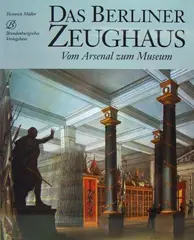
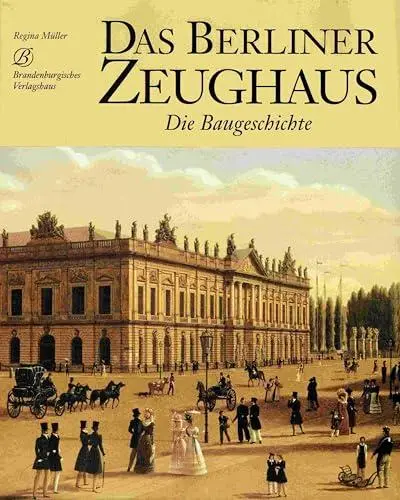
Das Berliner Zeughaus. Die Baugeschichte
Müller, Regina / Müller, Heinrich
€ 14.45
In stock (only 1 copy left). Shipping € 6.95 (in the Netherlands; for other rates see Terms and shipping).
Sadly, this book has been sold.
- Author
- Müller, Regina / Müller, Heinrich
- Publisher
- Deutsches Historisches Museum
- ISBN
- 9783894880552
- Language
- German
- Condition notes
- 1994, 344 pp, paperback, used
- Category
- Textbooks › Architecture
About this book
In the early modern period, the Zeughaus developed into a distinct architectural type. In the 16th century, it became part of prestigious architecture and was often designed by leading architects. The Zeughaus, built in the early 18th century in Berlin, the capital of the Prussian rulers, represents a significant contribution to this genre from the perspectives of architectural and art history.
The Berlin Armoury is one of the most important buildings of the North German Baroque period. Today, it marks the start of the central avenue ‘Unter den Linden’, which leads from the reconstructed City Palace to the Brandenburg Gate. The building, which initially served as an armoury, was intended to symbolise the claim to sovereignty of the emerging Electorate of Brandenburg, and subsequently the Kingdom of Prussia. This is where ‘war materiel’, or ‘Zeug’ for short – such as cannons, muskets and sabres – was kept. They were stored in such a way that, in the event of war, they would be ready for use and could be deployed quickly. The Zeughaus also housed military trophies captured during campaigns as mementoes, as well as weapons and flags that had fallen into disuse.
The idea for the construction of the Berlin armoury came from Elector Frederick William of Brandenburg. His son, Elector Frederick III, who was crowned King Frederick I of Prussia in 1701, put the plan into action. He laid the foundation stone in 1695. Four architects were successively involved in the new building opposite the castle: Johann Arnold Nering designed the building; after his death, Martin Grünberg took charge of the construction. Three years later, Andreas Schlüter took over this task. His successor, Jean de Bodt, completed the building in 1706 and gave it its final appearance. The final work on the interior was not completed until 1730. In total, construction took 34 years.
From 1877 to 1883, Emperor and King Wilhelm I had the arsenal converted into an arms museum with a hall of honour for the House of Hohenzollern and the Prussian army. A high domed hall was built on the north side and the courtyard was covered. Until 1945, the building served as an army museum. Unlike the Berlin City Palace opposite, the Zeughaus – which had also been severely damaged during the Second World War – was rebuilt. From 1952 to 1990, the Zeughaus housed the ‘Museum für Deutsche Geschichte’, the GDR’s central history museum. Since 1990, it has been home to the ‘Deutsche Historische Museum’.