
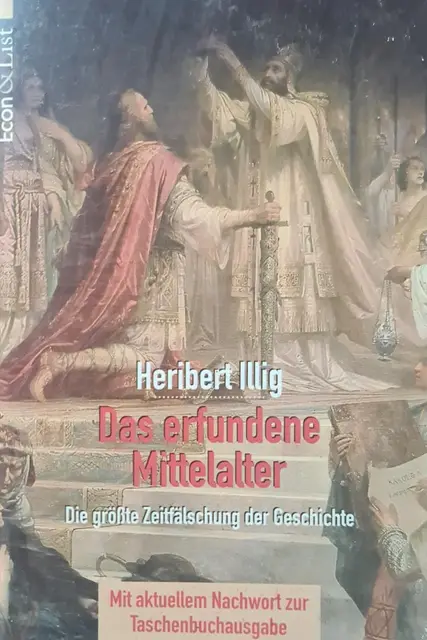
Das erfundene Mittelalter
Illig, Herrbert
€ 9.95
In stock (only 1 copy left). Shipping € 6.95 (in the Netherlands; for other rates see Terms and shipping).
Sadly, this book has been sold.
- Author
- Illig, Herrbert
- Publisher
- Econ & List
- ISBN
- 9783612264923
- Language
- German
- Condition notes
- 1996, 454 pp, paperback, used
- Category
- History
About this book
Perhaps the prophets weren’t wrong after all. The end of the world may well take place before the end of the millennium. But don’t panic – it’s only the year 1702. At least, if you are to believe Heribert Illig. He, the passionate chronologist who has already exposed 2,000-year-old Egyptian history as a figment of the imagination, now reveals in his bestseller *Das erfundene Mittelalter* the greatest chronological forgery in European history. “Sharpened by experiences with ancient chronologies, the accuracy of which does not stand up to closer scrutiny”, the darkness of the Middle Ages made him suspicious this time round. His research into the Gregorian calendar reform ultimately brought it to light. Around 300 years of history have been fabricated – ‘phantom time’ that ‘must be scrapped without replacement’. But let’s take it slowly. For it is none other than the illustrious forefather of the Christian West, Charlemagne (c. 742–814), who stands in the way of shortening the timeframe in European historiography more than anyone else. Yet it is precisely the almost Herculean life of this legendary hero – who flashes into view in the midst of the proverbial ‘Dark Ages’ only to vanish again into a saeculum obscurum – that has fuelled Illig’s doubts in the first place. “Charlemagne’s heroic deeds shine in the brightest light of history, bearing witness to the emergence of a united Europe. Yet they can barely conceal the ever-present contradictions. Every investigation reveals new incompatibilities and gaps, as if ‘He’ were a contradiction in terms, a wooden iron, an oxymoron”. True to Kurt Gödel’s insight that the totality of a (mathematical) theory can only be delineated from the outside by a metatheory, Illig self-assuredly regards himself as an “inexperienced outsider” who, with an “unbiased eye, sees a solution that the specialist, lost amidst ‘his’ trees, would never find”. Whilst medieval studies remained largely unmoved by the “new Däniken” in the early 1990s and his initial meagre evidence for “Charles the Fictitious”, it now seems, with the mounting evidence of archaeological, architectural and documentary anachronisms, more inclined towards a critical debate. --Roland Detsch